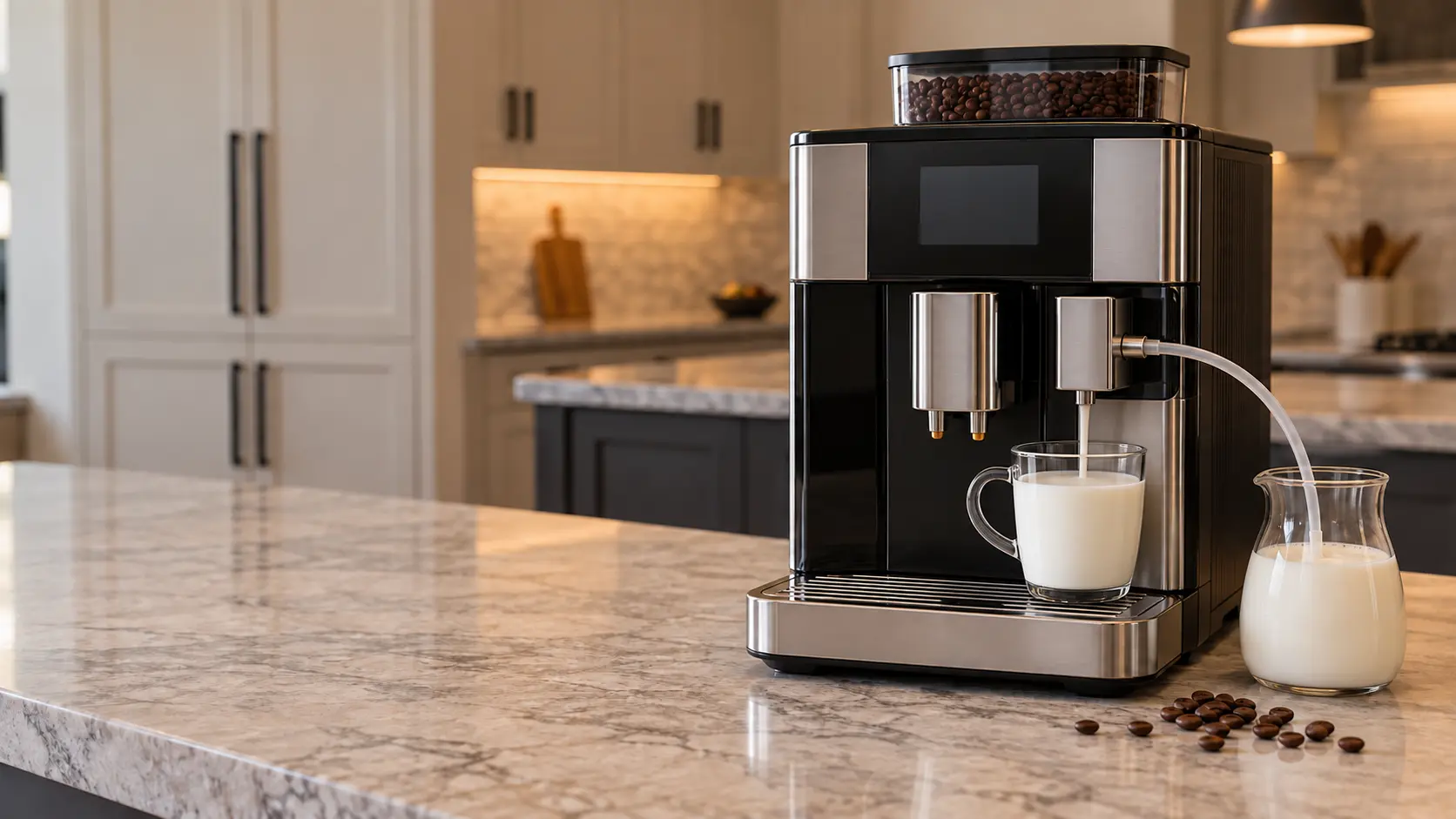
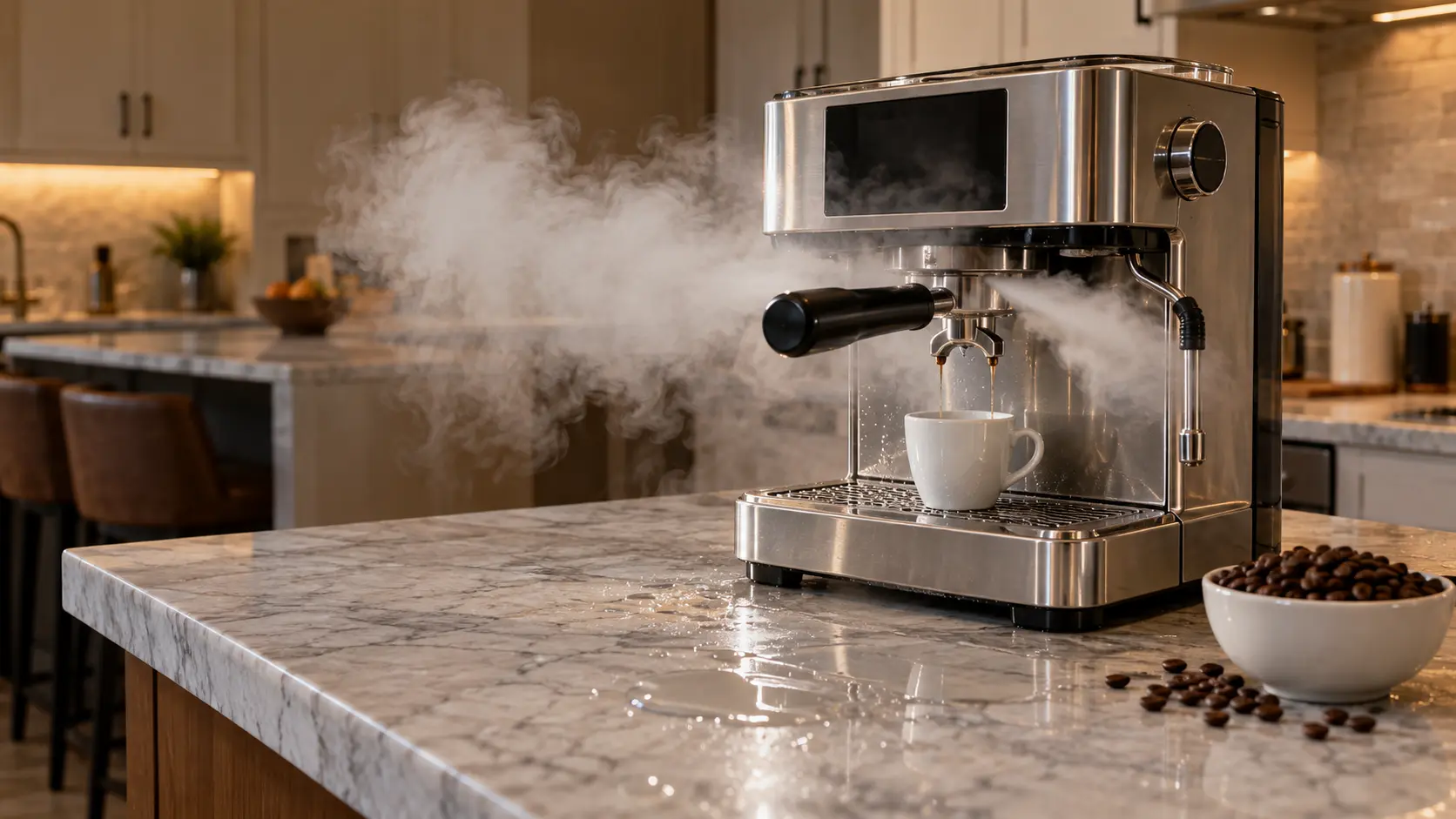
How a coffee machine turns milk into foam
Almost every fully automatic machine uses steam or hot water moving at speed to pull milk up a tube, and a tiny air opening beside it to whip air into the stream. The mix passes through a narrow chamber in the frother or outlet and comes out as foam. Three things have to be right at once: the milk, the air and the steam.
That design explains why most cases of coffee machine milk not frothing come down to something small. A film of dried milk the thickness of a fingernail is enough to narrow the air opening, and a tube that sits half a turn loose draws air where it should draw milk.
Start with the milk in the container
Warm milk foams badly and sprays. Miele's troubleshooting ties spraying and hissing to milk that is too warm and asks for milk colder than 50°F in its flask. Bosch asks for cold milk with at least 1.5 percent fat and rules out milk that has already been boiled.
A flask or carton that has stood on the counter through breakfast is the most common cause of a sudden change. Put it back in the refrigerator between drinks, or use a chilled container if the maker offers one.
- Use milk straight from the refrigerator, not milk that has been standing out.
- Try a fresh carton if the old one is near its date.
- Compare with whole milk before blaming the machine for a plant drink that froths weakly.
- Keep the container clean: old milk film inside it spoils the next batch.
Source: Miele — CVA 6405 built-in coffee system, operating and installation instructions — Good froth needs cold milk below 50°F; spraying and hissing from warm milk; flask not pushed in draws air; main dispenser mounted incorrectly; clean the flask lid, main dispenser and milk valve with the brush; dirty lid gives a false flask message; clean the main dispenser weekly; exchange the elbow connector behind the service cover; no needles; Bosch — BCM8450UC built-in coffee machine, use and care manual — Use cold milk with at least 1.5% fat, not milk already boiled; outlet or tubes assembled incorrectly, moisten and reassemble; limescale causes little or no froth and a milk system that does not take in milk

Tubes, joints and the air intake
When only hot milk comes out, air is either missing or entering at the wrong place. Miele names a flask that is not pushed all the way in, so it sucks in air along with the milk, and an outlet assembled incorrectly. Bosch says the same of a beverage outlet or milk tubes put together wrongly and suggests moistening the parts before reassembling them.
Check each joint by eye: the tube pressed fully onto its nozzle, the suction pipe seated in the container, no crack or split at the end of the tube.
Flask-fed built-ins
On a built-in that uses a milk flask on a shelf beside or inside the machine, the flask lid carries its own small channels. Miele asks for the lid to be taken apart and brushed; a dirty lid also makes the machine report an empty or missing flask when it is full.
Tube dipped into a carton or jug
Where the tube simply drops into a container, check that its end reaches the bottom and has not curled up out of the milk. A tube cut too short after cleaning, or one with a kink, starves the frother.
A steam wand on a manual espresso machine
Here the air comes from you: the wand tip just below the surface to draw air in, then deeper to heat and roll the milk. A wand tip blocked with dried milk gives weak, wet steam, so purge it and wipe it after every jug.
Source: Miele — CVA 6405 built-in coffee system, operating and installation instructions — Good froth needs cold milk below 50°F; spraying and hissing from warm milk; flask not pushed in draws air; main dispenser mounted incorrectly; clean the flask lid, main dispenser and milk valve with the brush; dirty lid gives a false flask message; clean the main dispenser weekly; exchange the elbow connector behind the service cover; no needles; Bosch — BCM8450UC built-in coffee machine, use and care manual — Use cold milk with at least 1.5% fat, not milk already boiled; outlet or tubes assembled incorrectly, moisten and reassemble; limescale causes little or no froth and a milk system that does not take in milk
Cleaning the milk path the way the makers ask
Dried milk is the steady cause behind most weak foam. JURA answers insufficient foam and spraying with its frother cleaning and a full dismantle-and-rinse; Miele calls for brushing the milk pipework in the flask lid, the main dispenser and the milk valve, and for cleaning the main dispenser weekly.
If you only have hot milk after all of that, Miele goes one step further: exchange the elbow connector supplied as a spare, reached through a service cover on the back of the door. It warns against needles or similar tools because they damage the parts.
- Run the machine's own milk rinse after the last milk drink of the session.
- Take the frother or outlet apart as the manual shows and brush every channel.
- Soak removable milk parts in the maker's milk cleaner when the display asks.
- Rinse the air intake opening under running water.
Source: Miele — CVA 6405 built-in coffee system, operating and installation instructions — Good froth needs cold milk below 50°F; spraying and hissing from warm milk; flask not pushed in draws air; main dispenser mounted incorrectly; clean the flask lid, main dispenser and milk valve with the brush; dirty lid gives a false flask message; clean the main dispenser weekly; exchange the elbow connector behind the service cover; no needles; JURA — E8 instructions for use — Insufficient foam or spraying: clean, dismantle and rinse the frother; little or no steam with a very quiet pump: connector blocked by milk residue or scale loosened by descaling
When the steam itself is weak
Scale in the steam path gives less force to pull milk and whip air. Bosch lists limescale first among the causes of little or no milk froth and of a milk system that stops taking in milk, and JURA links little or no steam, with a very quiet pump, to a frother connector blocked by milk residue or by flakes of scale loosened during descaling.
Descale on time and, after a descaling run, clean the frother once more to flush out anything the cycle loosened.
Source: Bosch — BCM8450UC built-in coffee machine, use and care manual — Use cold milk with at least 1.5% fat, not milk already boiled; outlet or tubes assembled incorrectly, moisten and reassemble; limescale causes little or no froth and a milk system that does not take in milk; JURA — E8 instructions for use — Insufficient foam or spraying: clean, dismantle and rinse the frother; little or no steam with a very quiet pump: connector blocked by milk residue or scale loosened by descaling