
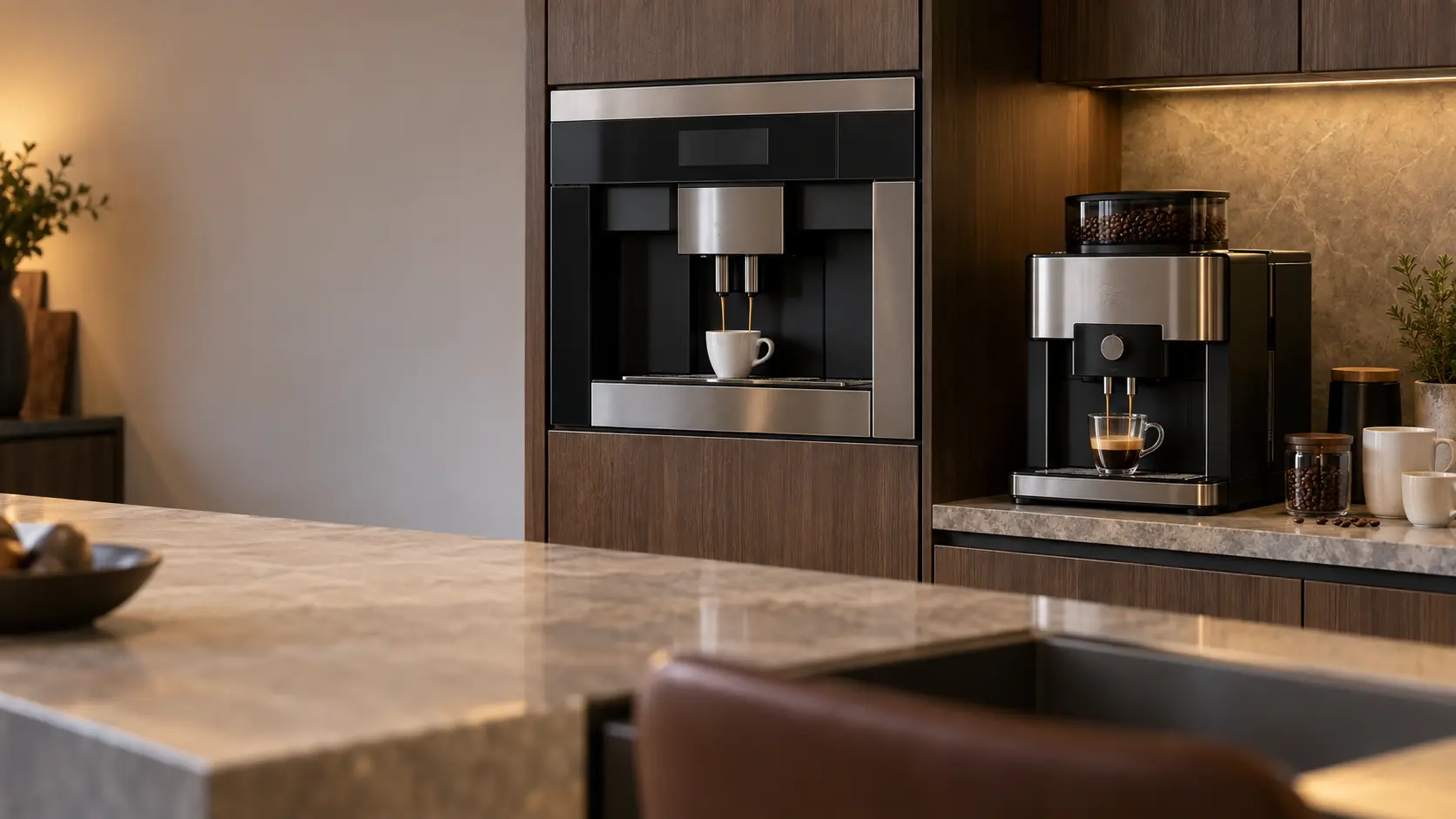

What actually differs between the two
Open the service door on a built-in coffee system and on a good countertop bean-to-cup machine and the parts look like cousins. Both grind whole beans, press the grounds in a brew chamber, push hot water through at pump pressure and dump the spent puck into a container. The coffee in the cup depends far more on the beans, the grind setting and how clean the brew unit is than on whether the machine sits in a cabinet.
The real differences are the enclosure, the water source and the way the machine is reached for maintenance. A built-in is designed around a cabinet opening and often a cold-water line. A countertop model is a freestanding appliance with its own feet, a cord and a tank you lift out by hand.
The differences at a glance
- Installation: a built-in needs a cabinet cutout, a power point inside the cabinet and sometimes a supply line; a countertop machine needs an outlet.
- Water: built-ins come as tank models or plumbed models; countertop machines are almost always tank-fed.
- Daily access: a built-in's tank, bean hopper and grounds container are reached through a front door; a countertop unit's are on top, at the front or on the side.
- Service: a built-in slides forward on rails; a countertop unit can be lifted onto a bench.
- Replacement: a new built-in must match the old cutout; a countertop machine only has to fit the counter.
The cabinet decides most of a built-in's life
A built-in coffee system usually goes into a tall cabinet, often stacked in a column with ovens, a warming drawer or a steam oven. That placement looks tidy, but it puts a machine that makes steam and hot water inside a closed wooden box. The maker's installation rules exist because heat and humidity have nowhere else to go.
Miele's installation instructions for its CVA 6405 built-in, for example, call for ventilation openings of a stated minimum area in the housing unit, warn that condensation can otherwise damage the machine and the cabinet, and say that a model installed behind a cabinet door may only be used with that door open. The same instructions give a room temperature range of 50°F to 100°F for operation.
Height and reach
Thermador recommends an installation height of about 37.5 to 57 inches for its 24-inch plumbed built-in, a band that keeps the spouts, the display and the front door within easy reach. Mount it too high and a shorter adult ends up reaching past a hot spout to take the cup; mount it too low and the tank and hopper become a crouching job every morning.
Power inside the cabinet
A built-in draws a full heating load while it brews and steams. Thermador's specification sheet for the TCM24PS lists 1,600 watts at 120 volts on a 15 A circuit. Plan the outlet where the maker's drawing puts it, so the cord is neither stretched nor folded behind the machine when it slides home.
Source: Miele — Operating and Installation Instructions, CVA 6405 built-in coffee system (en-US) — Ventilation openings required in the housing unit; condensation can damage machine and cabinet; behind a cabinet door use only with the door open; operate in rooms from 50°F to 100°F

Where a countertop espresso machine wins
A countertop bean-to-cup machine asks nothing of the kitchen but a grounded outlet and some clear space above it for filling the bean hopper. It can move when the kitchen is remodeled, go with you when you sell the house, and be swapped for a newer model on a weekend. Nobody has to cut a cabinet or run a line.
It is also the easier machine to service. Many makes let the owner pull the brew unit out through a side panel for a weekly rinse, and a technician can lift the whole machine onto a bench, open the housing and reach every part without working inside a cabinet opening.
- Leave clearance above for lifting the hopper lid and at the side for the service door.
- Keep it off the edge of the counter, where the drip tray gets knocked on the way past.
- Keep the cord away from the sink and the drip tray, which overflows if it is forgotten.
Where a manual espresso machine fits
A manual machine with a portafilter is a different kind of appliance. You grind, dose and tamp by hand, lock the handle into the group and start and stop the shot yourself. It has fewer automated parts, but it rewards practice, and a household that wants a latte at the touch of a button is usually happier with a fully automatic machine.
Manual machines sit on the counter, and most are tank-fed. Their service points are the group gasket, the shower screen, the steam wand and scale in the boiler or thermoblock.
What a repair day looks like for each
When a built-in needs work inside the housing, the technician slides it forward on its rails or lifts it out of the cabinet with a second pair of hands, disconnects power and, on a plumbed model, closes the supply valve first. The work is done in your kitchen, and the cabinet around the machine is part of what has to be protected.
A countertop model can usually be diagnosed on the counter where it sits. If a part has to be ordered, the machine can stay with you in the meantime, and nothing in the cabinetry is touched.
Choosing by household
A kitchen being designed from scratch, a household that pours many milk drinks a day and an owner who wants the counter clear all point toward a built-in. A rental, a kitchen that will not be remodeled, a single daily espresso, or an owner who wants the easiest possible repair all point toward a countertop machine.


