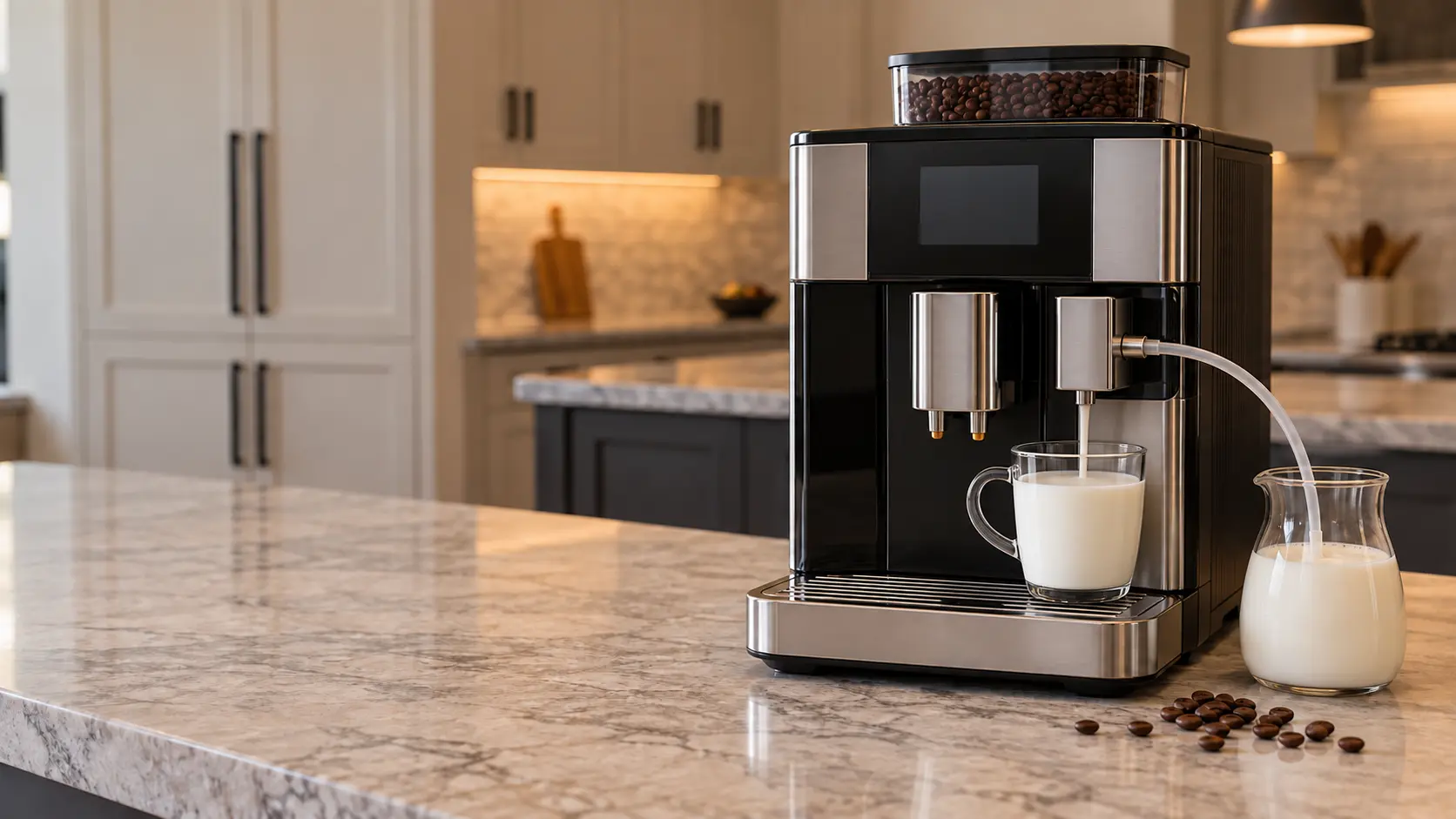
Why the milk side needs its own routine
The coffee side of a machine handles water, ground coffee and oil. The milk side handles a perishable food at body-warm temperatures, through narrow tubes, a valve and a frother nozzle that mixes in air. Anything left behind after a drink sits in a warm, damp place until the next one.
Makers write this into their manuals in strong terms. Miele's CVA 6405 manual treats leftover milk inside the machine as a health risk, and says all parts of the milk system need thorough, regular cleaning. JURA warns that cleaners it does not recommend leave milk residue behind, which can block its frother until it flies off the machine with a discharge of hot steam.
What should go into it
Miele asks for plain milk only, since most sugary additives can clog the milk lines, and for dairy milk to be pasteurized. It also notes that good foam needs cold milk, below 50°F. Flavored creamers and syrups belong in the cup after the drink is made, never in the milk container.
Source: Miele — Operating and Installation Instructions, CVA 6405 built-in coffee system (en-US) — Milk residues can go off and pose a health risk; plain, pasteurized milk below 50°F; flask not cooled in the machine; automatic milk rinse after a drink; flask and lid daily; lid disassembly and brushing; milk valve weekly with the brush removed before confirming; milk pipework cleaned about weekly, 3-day countdown, milk drinks blocked, about 15 minutes, one packet of cleaner; JURA — E8 Instructions for Use (North America) — Milk rinse prompted or automatic 10 minutes after a milk drink; clean the frother daily when milk is used; rinse the milk pipe and frother; cleaner and water marks, 8.5 oz fresh-water rinse; only JURA milk system cleaner, other agents can block the frother; cleaner harmful if swallowed
After every milk drink: the rinse
The first line of defense runs itself. Miele's CVA 6405 shows a rinse message a few minutes after a milk drink and rinses the milk pipework automatically after some time even if nobody confirms it. JURA's E8 can be set either to prompt for the milk rinse 10 minutes after a milk drink or to start it on its own.
Let the rinse happen. Switching the machine off at the wall right after a cappuccino, or pulling the milk tube before the rinse, leaves milk standing in the line. Keep a cup or small container under the spout for the rinse water, which comes out hot. The milk itself goes straight back to the cold: FDA's guidance is a refrigerator at 40°F or colder, and no more than two hours at room temperature for foods that need refrigeration.
- Leave the machine on until the milk rinse has run.
- Keep the rinse setting on automatic if the model offers it.
- Put the milk back in the refrigerator right after the drink.
- Rinse the milk container's lid under running water before storing it.
Source: Miele — Operating and Installation Instructions, CVA 6405 built-in coffee system (en-US) — Milk residues can go off and pose a health risk; plain, pasteurized milk below 50°F; flask not cooled in the machine; automatic milk rinse after a drink; flask and lid daily; lid disassembly and brushing; milk valve weekly with the brush removed before confirming; milk pipework cleaned about weekly, 3-day countdown, milk drinks blocked, about 15 minutes, one packet of cleaner; JURA — E8 Instructions for Use (North America) — Milk rinse prompted or automatic 10 minutes after a milk drink; clean the frother daily when milk is used; rinse the milk pipe and frother; cleaner and water marks, 8.5 oz fresh-water rinse; only JURA milk system cleaner, other agents can block the frother; cleaner harmful if swallowed; FDA — Are You Storing Food Safely? — Keep the refrigerator at or below 40°F; perishable foods should not sit at room temperature for more than two hours

Daily and weekly cleaning by hand
A rinse clears the path but not the fat that settles in the container and its lid. Miele lists the milk flask and lid as a daily job at the end of the day, and warns that milk fat deposits in the lid make milk spray when froth is made. JURA asks for its frother to be cleaned daily whenever milk has been prepared.
The flask and its lid
On the Miele CVA 6405, the glass flask goes through the dishwasher or gets washed by hand. Before the lid goes in, the owner pulls the milk intake tube and its seal from the lid, rinses both, and runs the supplied brush through the stainless tube until no deposits remain. If water will not run through the lid's own milk passage, the lid is taken apart and brushed.
The milk valve
Miele asks for the milk valve to be cleaned once a week. A maintenance menu item moves the valve into a service position, the owner works the supplied brush back and forth in it, removes the brush and confirms, and the machine rinses the pipework. Miele warns that confirming with the brush still inside damages the machine.
Tube-fed countertop machines
Machines that draw milk through a tube dipped in a carton or jug have fewer parts, but the tube and its connector hold the same film. JURA's E8 manual asks for the milk pipe to be removed and rinsed thoroughly under running water, and for the frother to be taken apart and rinsed.
Source: Miele — Operating and Installation Instructions, CVA 6405 built-in coffee system (en-US) — Milk residues can go off and pose a health risk; plain, pasteurized milk below 50°F; flask not cooled in the machine; automatic milk rinse after a drink; flask and lid daily; lid disassembly and brushing; milk valve weekly with the brush removed before confirming; milk pipework cleaned about weekly, 3-day countdown, milk drinks blocked, about 15 minutes, one packet of cleaner; JURA — E8 Instructions for Use (North America) — Milk rinse prompted or automatic 10 minutes after a milk drink; clean the frother daily when milk is used; rinse the milk pipe and frother; cleaner and water marks, 8.5 oz fresh-water rinse; only JURA milk system cleaner, other agents can block the frother; cleaner harmful if swallowed
The milk cleaning program
Rinsing and brushing do not dissolve milk protein baked onto hot surfaces inside the machine. That is the job of the cleaning program, run with the maker's own milk cleaner. Miele's CVA 6405 asks for it about once a week, counts down the days on the display from three days before, and stops making milk drinks until it has been done. The program takes about 15 minutes, with one packet of Miele's milk cleaner dissolved in lukewarm water to the cleaning mark.
On JURA's E8, cleaner goes into the front of the supplied container to the lower mark, water to the upper mark, and the milk pipe is connected to the container while the program runs. The container is then rinsed and 8.5 oz of fresh water is run through. JURA says to use only its own milk system cleaner and warns that the cleaner is harmful if swallowed; keep it away from children.
- Use the cleaner the maker names, measured to its mark.
- Connect the milk tube or fit the flask exactly as the display shows.
- Rinse the tank or container thoroughly afterward so no cleaner reaches a drink.
- Store the cleaner where children cannot reach it.
Source: Miele — Operating and Installation Instructions, CVA 6405 built-in coffee system (en-US) — Milk residues can go off and pose a health risk; plain, pasteurized milk below 50°F; flask not cooled in the machine; automatic milk rinse after a drink; flask and lid daily; lid disassembly and brushing; milk valve weekly with the brush removed before confirming; milk pipework cleaned about weekly, 3-day countdown, milk drinks blocked, about 15 minutes, one packet of cleaner; JURA — E8 Instructions for Use (North America) — Milk rinse prompted or automatic 10 minutes after a milk drink; clean the frother daily when milk is used; rinse the milk pipe and frother; cleaner and water marks, 8.5 oz fresh-water rinse; only JURA milk system cleaner, other agents can block the frother; cleaner harmful if swallowed
A steam wand on a manual machine
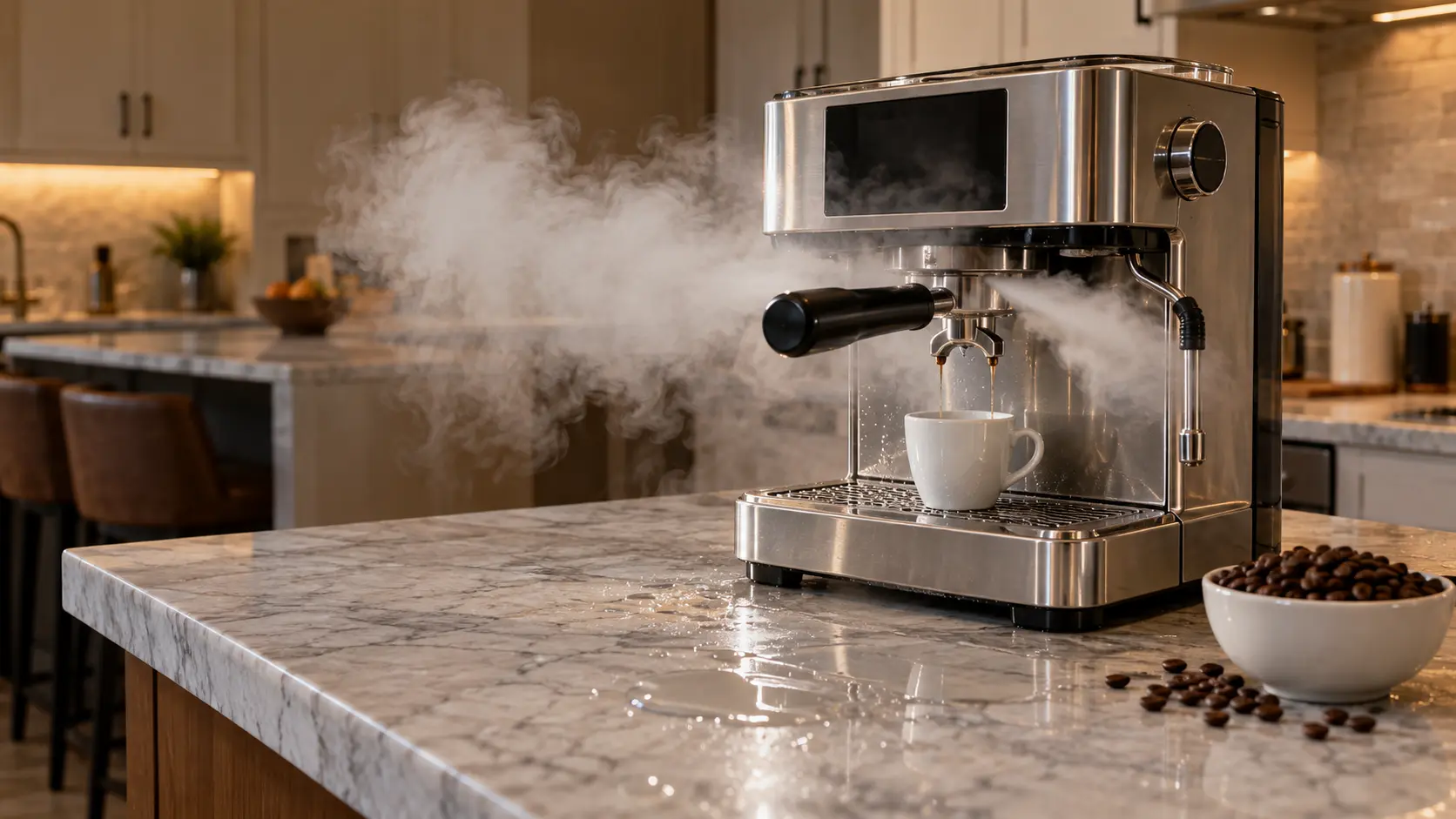
A manual espresso machine froths with an open steam wand instead of a milk circuit, which makes the routine simpler but no less urgent. Wipe the wand with a damp cloth straight after frothing and purge a short burst of steam into the drip tray so milk drawn back into the tip is blown out. Milk dried on a wand is far harder to remove than milk wiped off warm.
Keep your hand and the cloth clear of the tip when the steam is purged, and point the wand down into the tray.