What a plumbed coffee system does with the water
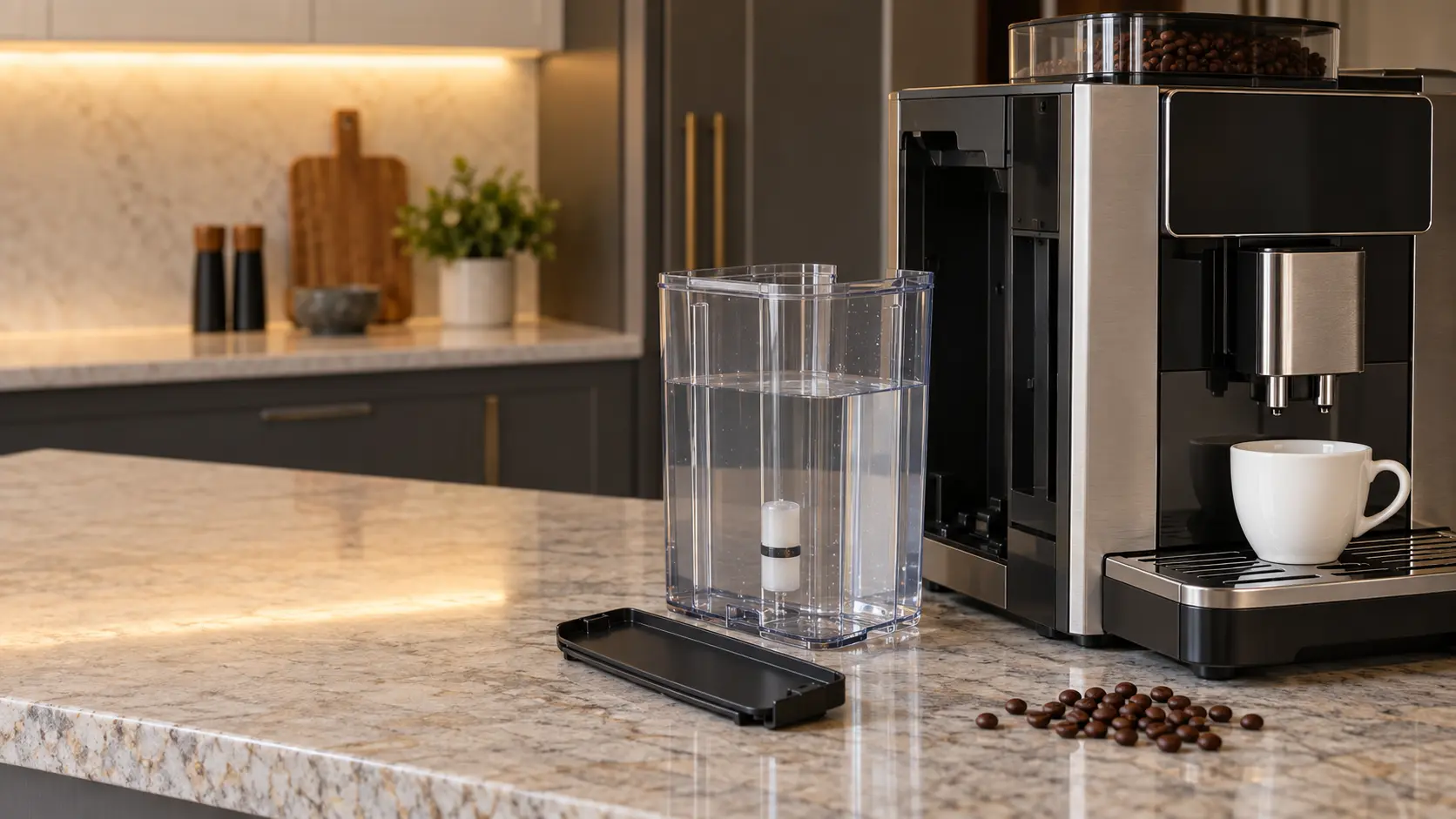
Most plumbed built-ins still have a tank. The house line feeds it through an inlet valve, and the machine tops it up by itself whenever it is on. Miele describes an intake device in the tank lid that lets the water in slowly, and lets the owner switch the connection off in the menu and fill by hand if needed.
Because the tank is still there, the daily habits do not disappear. Miele still asks for the tank on a plumbed machine to be emptied once a day, and for the first full tank to be discarded after the machine has stood unused for a long time, since water left in the supply hose affects the taste.
Tank models and plumbed models are not interchangeable
Several makers sell the same built-in in a tank version and a plumbed version, and the plumbed one carries its own connections at the back. Thermador's plumbed 24-inch model, for example, shows a cold-water connection and an electrical terminal box on its connection drawing. Check the exact model before the cabinet is planned; a tank model cannot simply be hooked up later.
Filling by hand while the line waits
If the machine arrives before the plumber, or the line has to be closed for a repair later, a Miele plumbed model can still run: switching the water connection off in the settings turns it back into a tank machine that you fill with fresh, cold water. Turn the connection back on only after the valve has been opened and the joints checked.
Source: Miele — CVA 6405 built-in coffee system, operating and installation instructions — Connection by a qualified professional with power off and supply shut; cold line only, directly connected so water circulates; 14.5 to 145 psi; brass adapter to 1/4 in compression supplied, line not included; accessible shutoff valve; no old hoses; hand-tighten, open slowly and check for leaks; empty the tank daily and discard the first tank after long non-use; no reverse-osmosis water; close each appliance's supply for a vacation; the water connection can be switched off in settings to fill the tank manually
The supply line the installer runs
Miele's instructions set out the requirements for a plumbed coffee system water connection plainly. The machine connects to a cold line only, never a hot one, taken directly from the supply so that water keeps moving through it; a long dead-end branch where water sits for days will show up in the taste of the coffee. Pressure must sit between 14.5 and 145 psi, and all fittings must meet national and local plumbing and hygiene codes.
The machine usually ships with an adapter rather than a complete kit. Miele supplies a brass fitting that converts its connector to a quarter-inch compression joint, and leaves the quarter-inch flexible line or copper tube to the installer.
- A cold supply, taken from a line that is used every day.
- Pressure within the limits in the installation manual.
- A dedicated shutoff valve on the branch to the machine.
- New hoses and gaskets; Miele forbids connecting old or used hoses.
- A route for the line that will not be crushed when the machine slides in.
Softeners and filters on the same line
If the house has a softener or a reverse-osmosis unit under the sink, tell the installer which tap the machine will share. Miele rules out reverse-osmosis water for its machines, so the branch for the coffee system has to be taken before that unit, not after it.
Source: Miele — CVA 6405 built-in coffee system, operating and installation instructions — Connection by a qualified professional with power off and supply shut; cold line only, directly connected so water circulates; 14.5 to 145 psi; brass adapter to 1/4 in compression supplied, line not included; accessible shutoff valve; no old hoses; hand-tighten, open slowly and check for leaks; empty the tank daily and discard the first tank after long non-use; no reverse-osmosis water; close each appliance's supply for a vacation; the water connection can be switched off in settings to fill the tank manually

The shutoff valve and where it should live
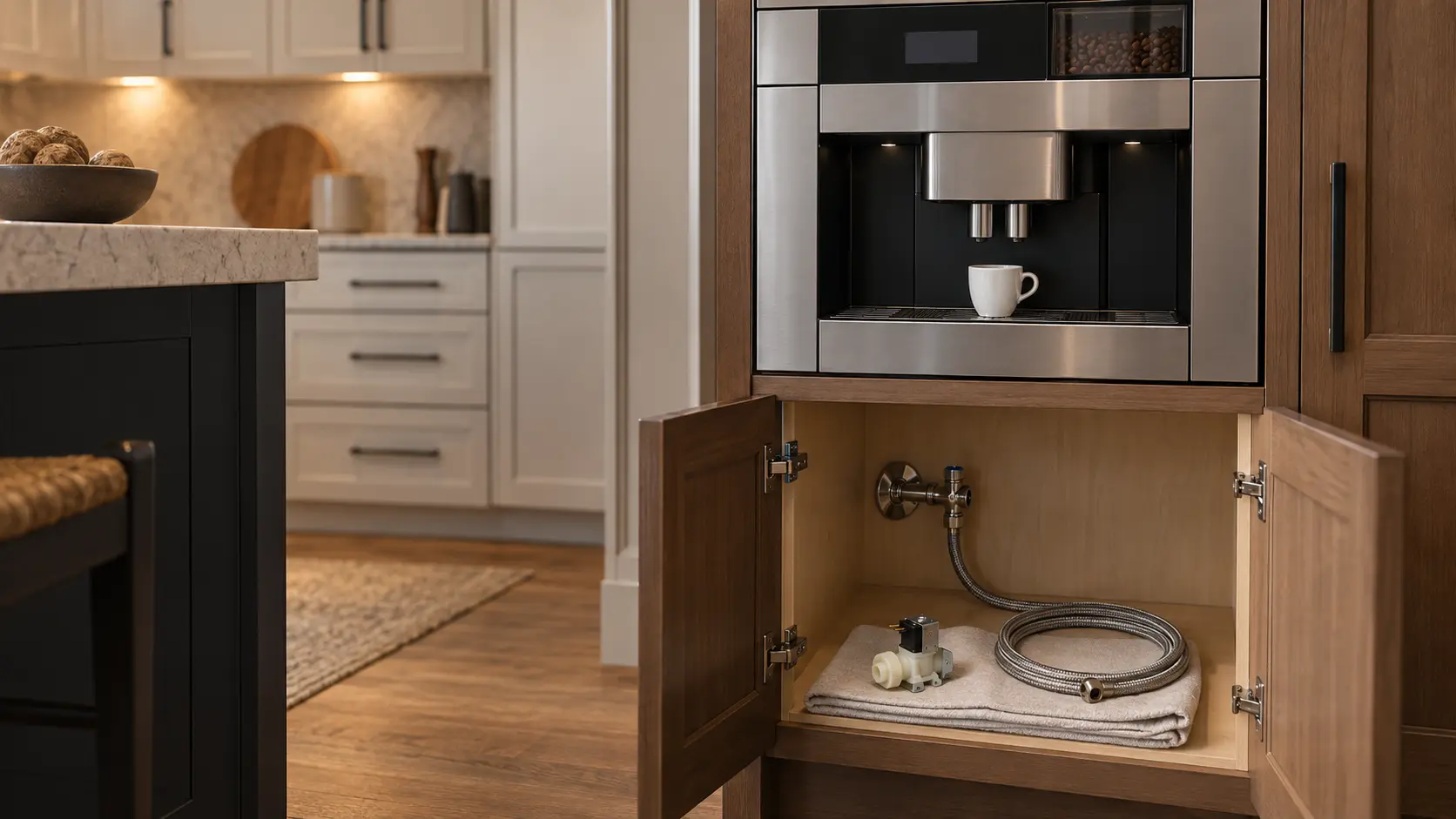
Miele's manual calls for a dedicated valve on the branch feeding the machine, fitted ahead of its stainless hose, and asks that it remain accessible once the machine is installed. A valve that ends up behind the machine in the tall cabinet meets the letter of that rule only if someone can reach it without taking the machine out.
The practical answer is a valve in the base cabinet below, behind a removable panel, or in the next cabinet over, with the line passing through a grommeted hole. Discuss the location before the cabinetmaker closes the back of the tall unit.
A valve you will actually use
Makers ask for the supply to be closed during long absences, and Miele adds that closing the house main is no substitute for closing each appliance's own valve. A valve at knee height behind a panel gets closed before a trip; one that needs a flashlight and a stepladder does not.
Source: Miele — CVA 6405 built-in coffee system, operating and installation instructions — Connection by a qualified professional with power off and supply shut; cold line only, directly connected so water circulates; 14.5 to 145 psi; brass adapter to 1/4 in compression supplied, line not included; accessible shutoff valve; no old hoses; hand-tighten, open slowly and check for leaks; empty the tank daily and discard the first tank after long non-use; no reverse-osmosis water; close each appliance's supply for a vacation; the water connection can be switched off in settings to fill the tank manually
What happens on connection day
The order in the installation manual is built around safety. The installer disconnects the machine from power before touching the water side, turns off the supply, checks that each fitting has its gasket, and tightens the connector on the machine by hand, as Miele specifies. The supply is then opened slowly and every joint watched for drips before the machine is pushed into its niche.
The last step matters because the connections disappear once the machine is in. A good installer runs the machine through a fill and a rinse, looks again at the joints with a dry paper towel and only then fixes the machine in the cabinet.
- Power disconnected before the water side is touched.
- Supply turned off and every gasket checked.
- The connector on the machine tightened by hand.
- Supply opened slowly and each joint watched for drips.
- A fill and rinse run before the machine is fixed in place.
What the owner can watch for afterwards
For the first week, open the base cabinet under the valve each morning and feel the shelf and the line with a dry hand. A dry paper towel folded under the valve shows a slow seep that the eye misses. Any dampness goes straight back to the installer.
Source: Miele — CVA 6405 built-in coffee system, operating and installation instructions — Connection by a qualified professional with power off and supply shut; cold line only, directly connected so water circulates; 14.5 to 145 psi; brass adapter to 1/4 in compression supplied, line not included; accessible shutoff valve; no old hoses; hand-tighten, open slowly and check for leaks; empty the tank daily and discard the first tank after long non-use; no reverse-osmosis water; close each appliance's supply for a vacation; the water connection can be switched off in settings to fill the tank manually