What water hardness does inside a coffee machine
The minerals that make water hard are mostly calcium and magnesium in solution. Every time the machine heats water, some of it stays behind as scale on the heater, in the valves and in the narrow tubes. Miele explains its hardness setting in exactly those terms: the harder the water, the more often the machine needs descaling.
The machine cannot see scale. It counts water and steam, multiplies by the coffee machine water hardness you entered, and asks for descaling when the total reaches its limit. Enter a value that is too soft and the request arrives late, after scale has already narrowed the paths; enter one that is too hard and you descale more often than you need to.
What scale looks like from the outside
You will rarely see it directly. The signs are slower drinks, coffee that is not as hot as it was, a pump that sounds strained and a white crust around the water tank valve. By the time these show, a descaling cycle is overdue.
Source: Miele — CVA 6405 built-in coffee system, operating and installation instructions — Harder water means more frequent descaling; the machine counts water and steam used; test strip dipped about one second, read after about a minute; the water authority can give the hardness; four levels in gr/gal, factory level 3; no mineral or reverse-osmosis water; change the water daily
Measuring your water before the first cup
Almost every maker packs a test strip in the box. Miele's instructions are typical: dip the strip in drinking water for about a second, shake it off and read the result after about a minute. JURA asks for the strip to be held under running water for a second, and counts the fields that turn red.
If the strip is lost, the local water utility can give you the figure; Miele suggests asking them. Utilities often quote hardness in milligrams per liter as calcium carbonate, while the machine's menu may use grains per gallon or German degrees, so convert before you choose a level. One grain per gallon is about 17.1 milligrams per liter.
| USGS class | mg/L as calcium carbonate | About grains per gallon |
|---|---|---|
| Soft | 0 to 60 | 0 to 3.5 |
| Moderately hard | 61 to 120 | 3.6 to 7.0 |
| Hard | 121 to 180 | 7.1 to 10.5 |
| Very hard | More than 180 | More than 10.5 |
Homes on a private well
There is no utility report for a well, so the strip is the only quick answer. USGS notes that hardness is a particular concern with groundwater, which is why a house on a well should test again after any change to its treatment equipment.
Source: USGS — Hardness of Water — 0 to 60 mg/L as calcium carbonate is soft, 61 to 120 moderately hard, 121 to 180 hard, more than 180 very hard; groundwater systems are concerned with hardness; Miele — CVA 6405 built-in coffee system, operating and installation instructions — Harder water means more frequent descaling; the machine counts water and steam used; test strip dipped about one second, read after about a minute; the water authority can give the hardness; four levels in gr/gal, factory level 3; no mineral or reverse-osmosis water; change the water daily; JURA — E8 instructions for use — Hold the Aquadur strip under running water one second, read after about a minute; filter cartridge recommended at 10 °dH or more; sparkling mineral water and other liquids can damage the tank; fill with cold water only, never warm or hot
Setting the level on the machine
Makers use different scales, so read the numbers in your own manual rather than matching level names. Miele offers four levels in grains per gallon: soft up to 8.7, medium to 14.6, hard to 21.9 and very hard above that, with level 3 set at the factory. Bosch's built-in also has four levels, starts at level 4, and asks owners with a household water softener to choose level 3 or its softening-device setting.
Enter the value during first setup if the machine offers it, or later under settings. If you move house, install a softener or switch from a well to city water, change the setting the same day.
- Read the strip or the utility figure and note the unit it uses.
- Convert it to the unit your machine's menu shows.
- Pick the level whose band contains your number, not the nearest name.
- Recheck after any change to the house water.
Source: Miele — CVA 6405 built-in coffee system, operating and installation instructions — Harder water means more frequent descaling; the machine counts water and steam used; test strip dipped about one second, read after about a minute; the water authority can give the hardness; four levels in gr/gal, factory level 3; no mineral or reverse-osmosis water; change the water daily; Bosch — BCM8450UC built-in coffee machine, use and care manual — Preset hardness level 4; level 3 or the softening-device setting with a house softener; filter lowers limescale and improves taste; rinse a new filter with a 17 oz container; replace at the message or after two months at the latest; rinse after a long absence; no chemically softened water
The filter cartridge: when to use it and how to change it
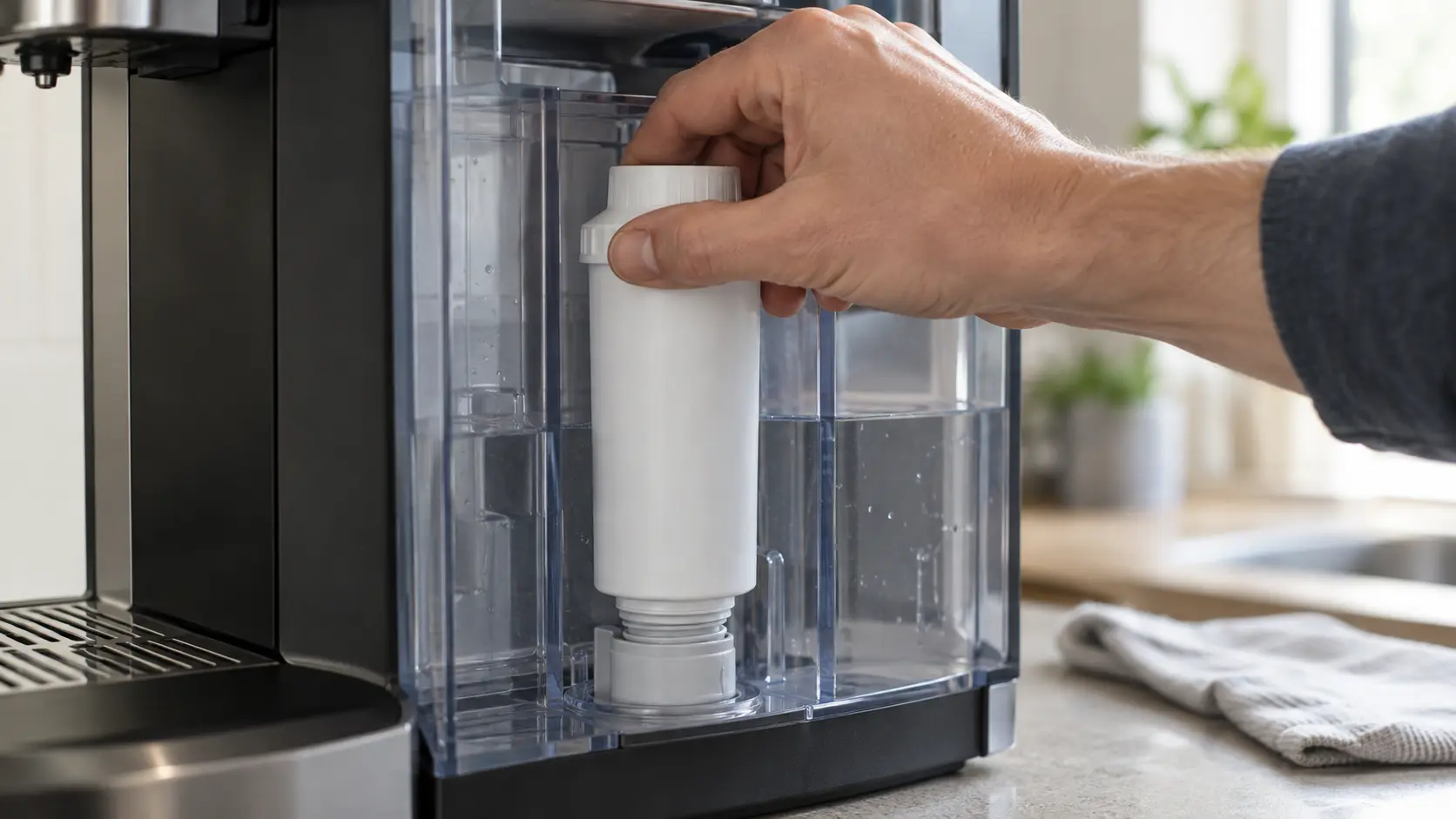
A cartridge in the tank takes out part of the hardness before the water reaches the heater, and it also improves taste. Bosch describes its filter as lowering limescale, reducing impurities and improving the coffee. JURA recommends its cartridge wherever the water is 10 German degrees or harder, which is about 10.5 grains per gallon.
The cartridge works only if the machine knows it is there. On most makes you tell the menu that a filter is inserted, replaced or removed, and a new cartridge must be rinsed before the first drink. Bosch has you place a 17-ounce container under the outlet for that rinse.
- Register the cartridge in the menu as inserted or replaced.
- Rinse a new cartridge through before the first drink.
- Change it when the display asks, or at the maker's time limit.
- Choose remove in the menu if you stop using one.
How long a cartridge lasts
Bosch treats its filter as spent when the replace message appears, or after two months at the latest, and says it must be changed for sanitation as well as scale. A cartridge left in past its date can hold stale water and stops protecting the heater, so an expired cartridge gives protection only on paper.
After the machine has stood unused
Water sitting in a cartridge for a week or more is not fresh. Bosch asks for the filter to be rinsed after a long break, such as a vacation, by dispensing a cup of hot water before the first coffee.
Source: Bosch — BCM8450UC built-in coffee machine, use and care manual — Preset hardness level 4; level 3 or the softening-device setting with a house softener; filter lowers limescale and improves taste; rinse a new filter with a 17 oz container; replace at the message or after two months at the latest; rinse after a long absence; no chemically softened water; JURA — E8 instructions for use — Hold the Aquadur strip under running water one second, read after about a minute; filter cartridge recommended at 10 °dH or more; sparkling mineral water and other liquids can damage the tank; fill with cold water only, never warm or hot
Water to keep out of the tank
The right water is fresh, cold tap water. Miele warns against mineral water, which leaves heavy scale, and against water from a reverse-osmosis unit, which it says will damage the machine. Bosch cautions against chemically softened water in its safety section, and JURA warns that sparkling mineral water and other liquids can damage its tank.
Warm or hot water from the tap is also ruled out by several makers, and the tank should be emptied and refilled every day, even on a plumbed machine that fills itself.
Source: Miele — CVA 6405 built-in coffee system, operating and installation instructions — Harder water means more frequent descaling; the machine counts water and steam used; test strip dipped about one second, read after about a minute; the water authority can give the hardness; four levels in gr/gal, factory level 3; no mineral or reverse-osmosis water; change the water daily; Bosch — BCM8450UC built-in coffee machine, use and care manual — Preset hardness level 4; level 3 or the softening-device setting with a house softener; filter lowers limescale and improves taste; rinse a new filter with a 17 oz container; replace at the message or after two months at the latest; rinse after a long absence; no chemically softened water; JURA — E8 instructions for use — Hold the Aquadur strip under running water one second, read after about a minute; filter cartridge recommended at 10 °dH or more; sparkling mineral water and other liquids can damage the tank; fill with cold water only, never warm or hot