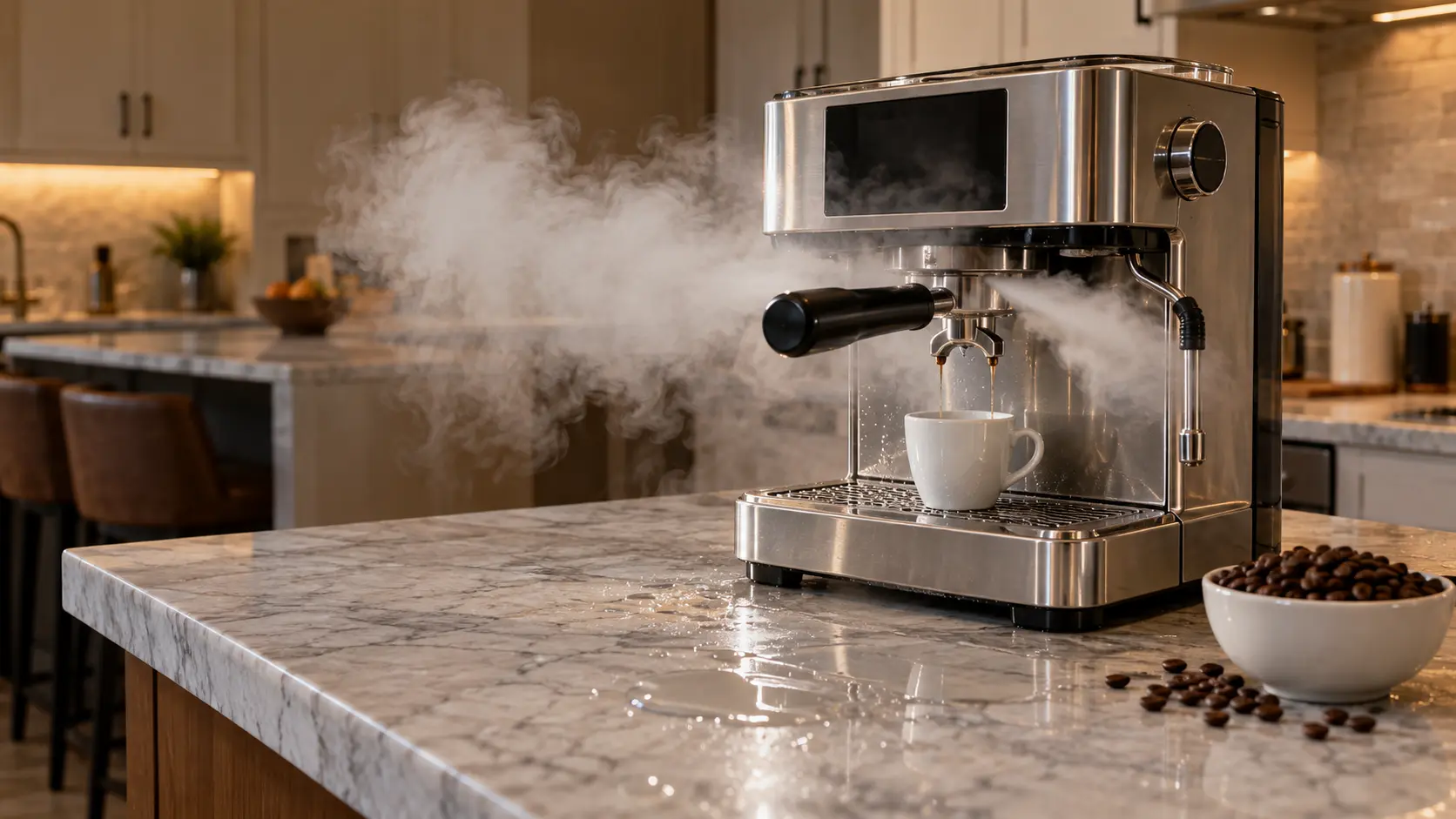
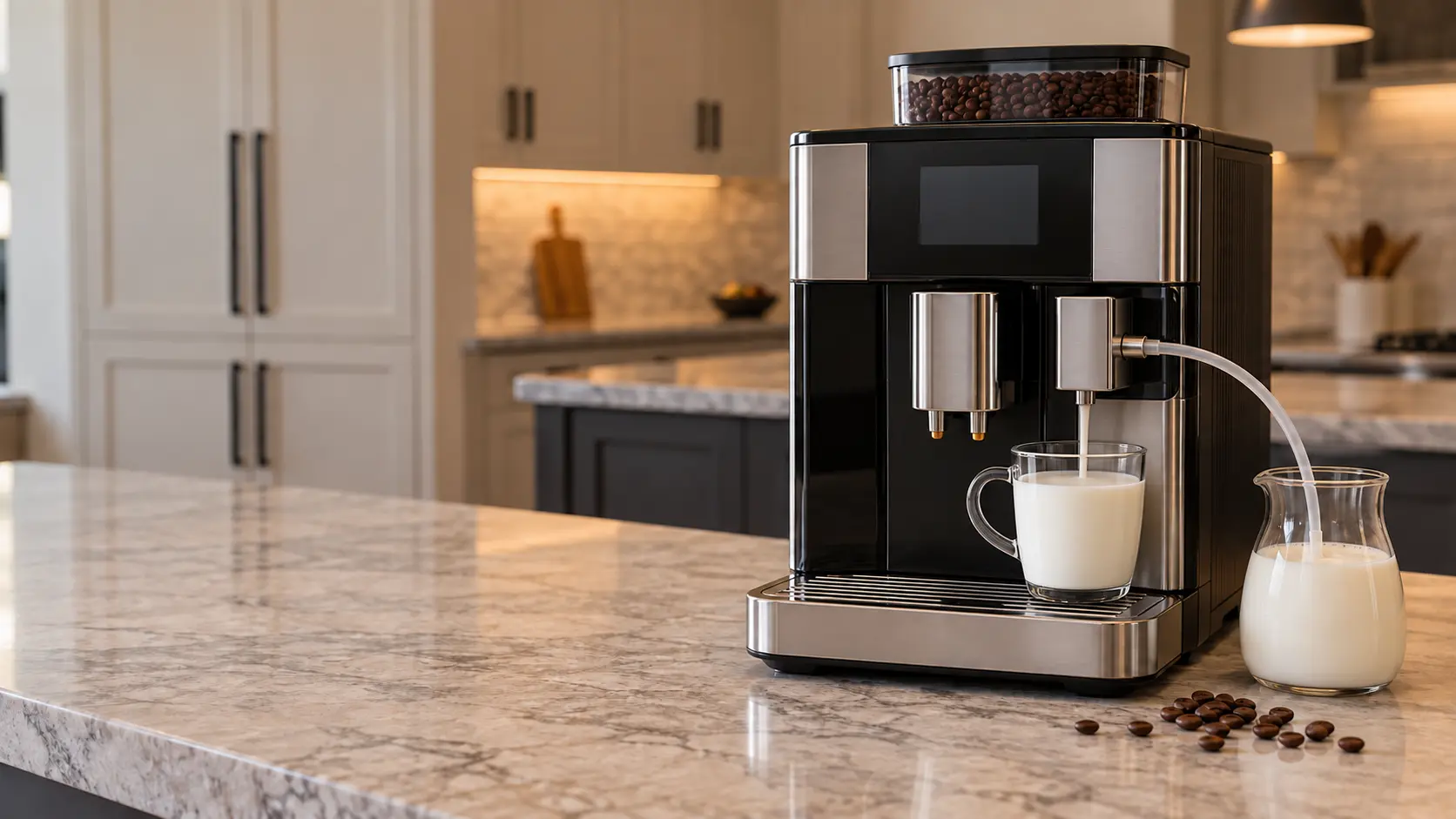
The first seconds: distance before the off switch
Steam burns faster than hot water because it releases more heat as it condenses on skin. The instinct to put a hand over the jet, or to pull the cup away from under it, is the one that ends in a burn, so the first move is backward, not forward.
Then switch the machine off. On most makes the on/off key sits on the front panel away from the spouts; if the spray covers the panel, or the machine sits in a tall cabinet with the spray at face height, use the breaker instead. A spray that stops the moment power goes off has told you it came from the heating circuit, which is useful to the technician.
- Step back and send children and pets to another room.
- Switch off at the front key if it is clear of the spray, otherwise at the breaker.
- Leave the cup where it is; it can be collected once cool.
- Wait at least half an hour before touching the spouts, the frother or the tray.
If someone has been scalded
JURA's instructions put it plainly: rinse the affected area with cold water and seek medical attention. Keep the cool water running over the skin rather than applying ice, and do not leave a child alone while a parent deals with the machine.
Children and a machine started from a phone
Miele reminds owners that children's skin is far more sensitive to heat than an adult's, and asks that they never put a hand under the dispensers. Bosch adds a warning of its own for machines that can be started from an app: whoever is standing at the machine when a drink starts remotely can be scalded. Keep remote start off in a house with small children.
Why a coffee machine sprays where it should not
Nearly every case of a coffee machine spraying steam comes from a path that is narrowed or open where it should be closed. Steam and hot water are pushed out under pressure, and they leave by the easiest route: around a frother pushed on half a click, past a milk tube that popped off, or through a dispenser clogged with dried milk.
Miele states that hot liquid or steam can spatter from the spouts when the main dispenser is dirty or not installed correctly. JURA makes the same point about its frother, which can come off if it is fitted wrongly or blocked.
A frother or milk spout that has worked loose
Milk parts come apart for cleaning every day, and every day there is a chance to put one back slightly crooked. A frother that sits a millimeter low can hold during a latte and let go during the steam rinse that follows it, which is why the spray often surprises people after the drink has finished.
Dried milk narrowing the path
Milk left to dry inside a spout or tube becomes a hard film that narrows the opening. The steam that used to leave through it now spits or sprays sideways. A thorough manual cleaning of the milk parts, as the manual describes it, often cures the spray entirely.
The steam wand on a manual espresso machine
On a portafilter machine the wand is under your control, and the risk is at the start and the end. Purge it into the drip tray with the tip pointing down and away from your hand, keep the tip below the milk surface while steaming, and close the knob before lifting the pitcher away.
Source: JURA — E8 instructions for use — Rinse a scald with cold water and seek medical attention; a frother fitted incorrectly or blocked can come off; pull the drip tray only when the display asks or the machine is ready; Miele — CVA 6405 built-in coffee system, operating and installation instructions — Children's skin is more sensitive to heat; hot liquid or steam can spatter from a dirty or badly fitted dispenser; drip tray water can be very hot; no steam cleaner; no flaming drinks under the dispenser

Hot parts that stay hot after the drink
A burn does not need a spray. Bosch warns that its beverage outlet gets very hot and must cool before it is touched, and that the heating element surfaces keep their heat after use. Miele adds that the water collected in the drip tray can be very hot and asks for care when emptying it.
That makes the tray one of the most common small burns in a kitchen with a fully automatic machine, because it is emptied right after the rinse cycle when the water in it is freshest. Let it stand a few minutes, carry it level and pour it into the sink rather than against your wrist.
Source: Miele — CVA 6405 built-in coffee system, operating and installation instructions — Children's skin is more sensitive to heat; hot liquid or steam can spatter from a dirty or badly fitted dispenser; drip tray water can be very hot; no steam cleaner; no flaming drinks under the dispenser; Bosch — BCM8450UC built-in coffee machine, use and care manual — Risk of scalding when a drink is started remotely; the beverage outlet gets very hot and heating surfaces retain heat
What not to do while it is hot
Several habits turn a small problem into an injury or a larger repair. Each one below is on a maker's list of warnings or follows directly from one.
- Do not reach past the open front of a built-in to the brew unit while the machine is hot.
- Do not clean the machine with a steam cleaner; Miele warns steam can reach electrical parts and cause a short circuit.
- Do not place flaming drinks under the dispenser; Miele notes the flames can melt plastic parts.
- Do not pull the drip tray out during brewing; JURA asks you to remove it only when the display tells you or the machine is ready.
- Do not keep using a machine that sprays from the same place twice.
Source: JURA — E8 instructions for use — Rinse a scald with cold water and seek medical attention; a frother fitted incorrectly or blocked can come off; pull the drip tray only when the display asks or the machine is ready; Miele — CVA 6405 built-in coffee system, operating and installation instructions — Children's skin is more sensitive to heat; hot liquid or steam can spatter from a dirty or badly fitted dispenser; drip tray water can be very hot; no steam cleaner; no flaming drinks under the dispenser
After it cools: what an owner can check
Once the spouts are cool to the touch, take off the milk parts the way your manual shows, rinse them under warm water and look for a missing seal, a crack or a plug of dried milk. Refit each part until it clicks, run a hot-water rinse into a cup with everyone standing back, and watch.
If the spray returns with clean, correctly fitted parts, or if it came from anywhere other than the spouts and the frother, the cause is inside. Steam from the side of a countertop housing or from the door gap of a built-in points to a hose, a seal or a valve in the steam path, and those sit behind panels an owner should leave closed.