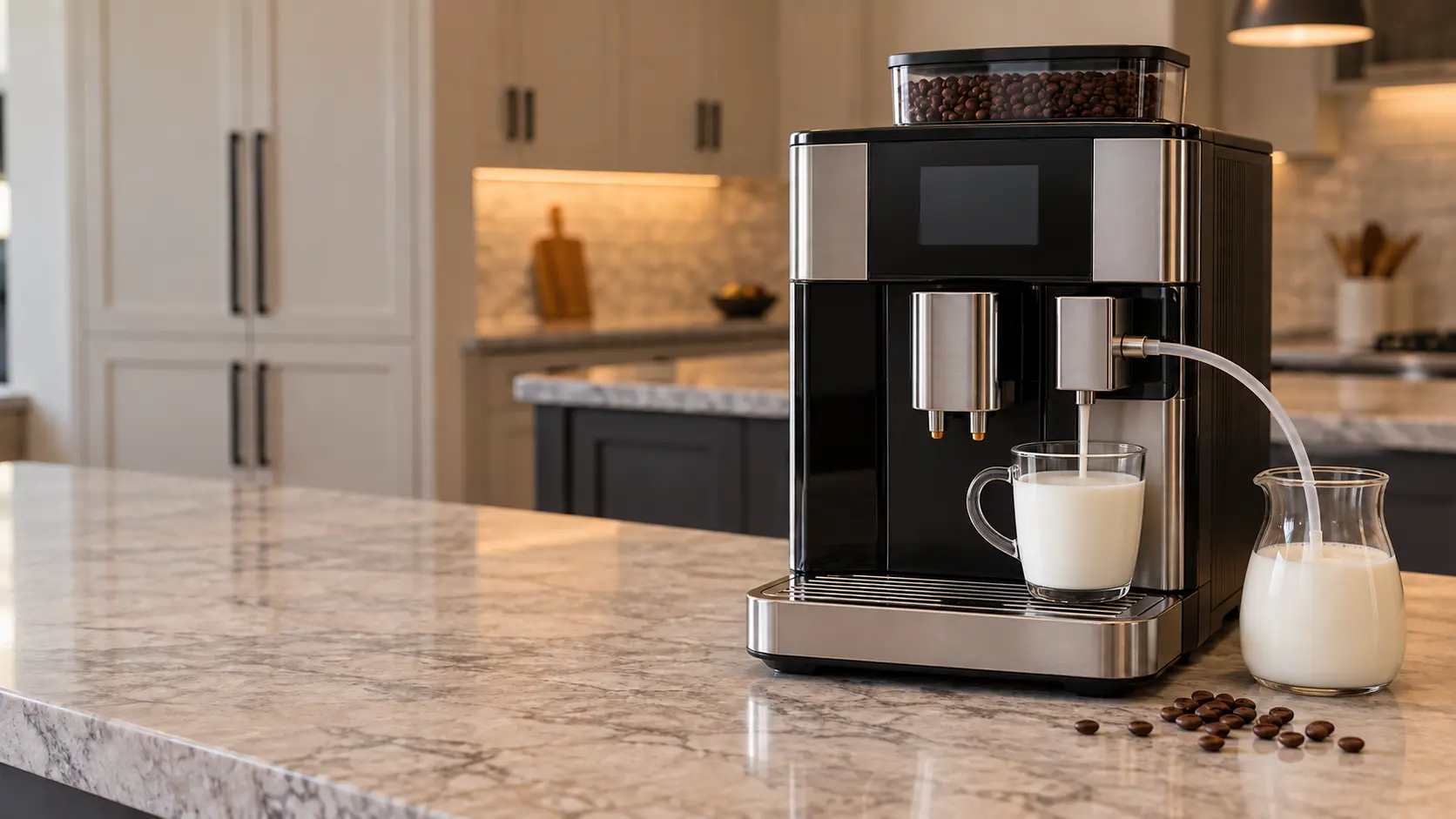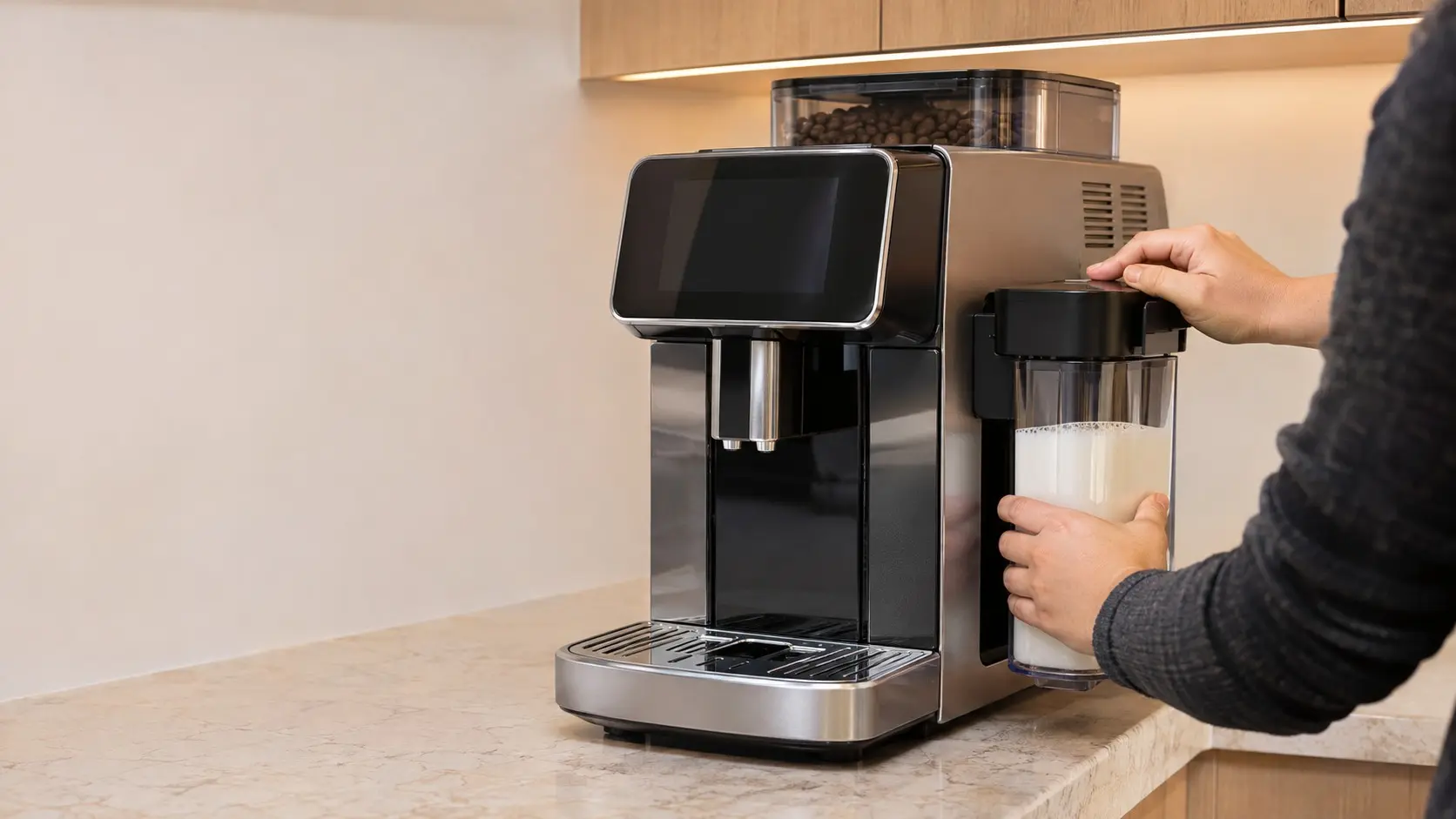

Why is the milk container not detected after cleaning?
Depending on the make, the machine detects the carafe through a contact, a magnet or a small switch at the coupling, and cleaning can change what that sensor sees. A wet contact, a lid that did not click, or a tube pushed on crookedly will each make the carafe read as absent.
Detection and milk flow are separate checks on many machines. The display can say "no container" even when the carafe is physically attached, because the sensor never closed. That is why a message right after a wash points at assembly, not at a failed part.
What should you check first?
Work from the simplest cause to the least likely one. Switch the machine off before touching the coupling, and wait a minute.
- Take the carafe off and look for any water in the socket on the machine.
- Dry the carafe's connection end and the machine's socket with a lint-free cloth.
- Remove the lid and check that the seal sits flat in its groove all the way around.
- Check that the tube and any air or froth part are pushed fully onto their stems.
- Fit the lid until it clicks, then seat the carafe firmly and switch the machine on.
Is the lid seal in the right place?
A lid seal that is twisted or half out leaves a gap, and some designs read that gap as a missing lid. Wash the seal separately, lay it back in its groove with a fingertip and press around the whole ring. If the seal looks stretched or flattened, it has done its time.
Are the small parts in the right order?
The froth part, the air inlet and the tube go together one way. A part fitted upside down can still look plausible. Compare with the diagram in your manual, or lay the carafe's parts out in the order you took them apart.
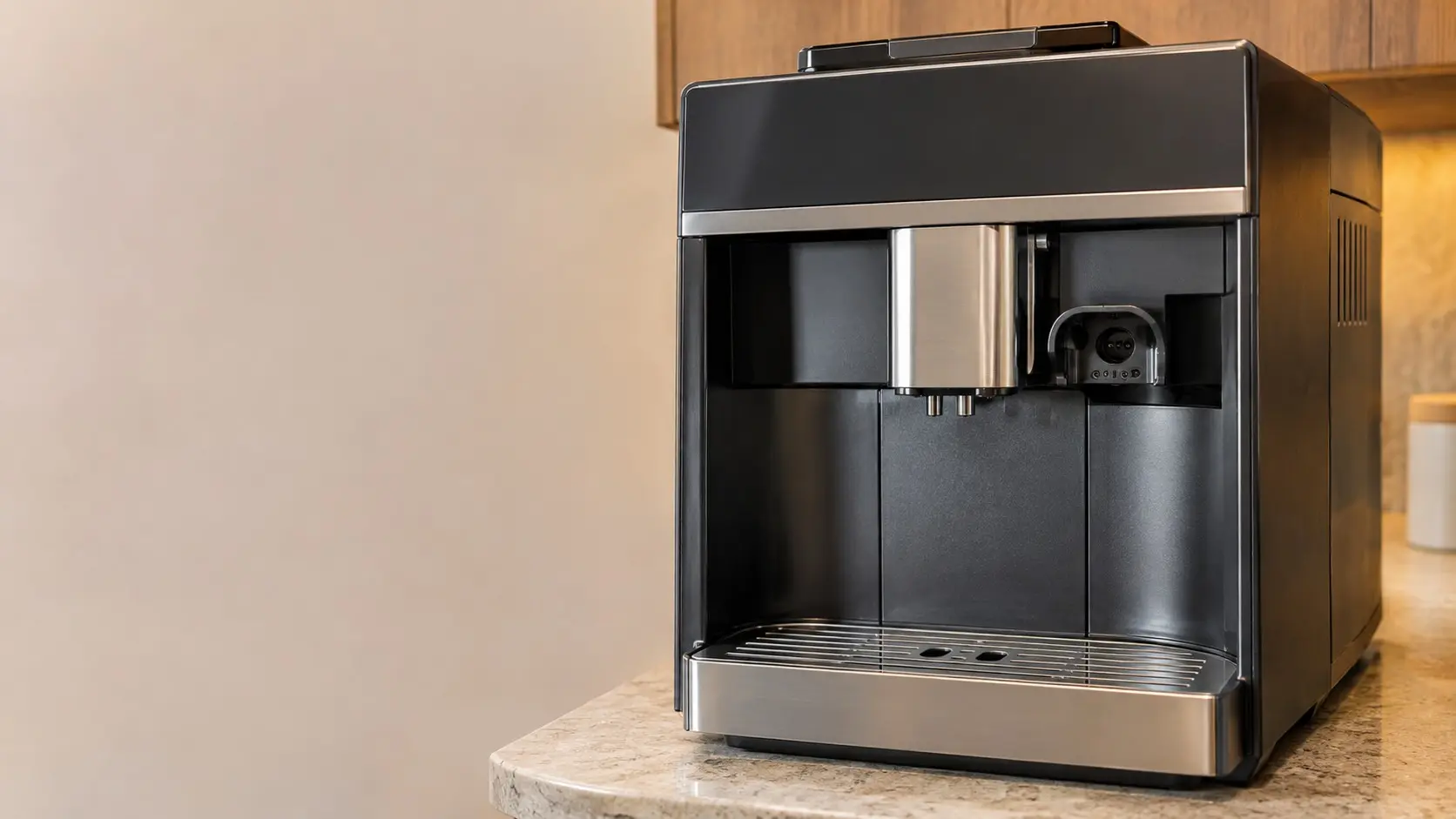
How does a damp contact cause this?
On machines that use electrical contacts, water across them can make the carafe read as absent, or make the reading come and go. Even a film of moisture after a rinse can do it.
How long should it dry?
Dry the area with a cloth and leave the carafe off, socket open to the air, until both the socket and the carafe's connector are fully dry. Avoid these shortcuts:
- A hair dryer on high heat, which softens plastic.
- Compressed air at close range, which pushes moisture deeper.
- Any metal tool on the contacts.
Table: Quick reference by what you see
| What you see | Likely cause | What to do |
|---|---|---|
| Water in the socket | Damp contact | Dry, wait until fully dry |
| Lid does not click | Seal or part misfit | Reseat seal, rebuild lid |
| Message with carafe seated | Sensor or board issue | Book a diagnostic visit |
| Milk dripping at the coupling | Worn gasket | Stop using the carafe |
What should you do after a clean refit?
Run a milk rinse or a short frothing cycle with water in the carafe to confirm the machine sees it and the path flows. Use water, not milk, for this first test so a failed attempt does not leave warm milk standing in the machine; the milk left standing guide explains why that matters.
If the water flows, the problem was assembly. If the message returns at once, switch the machine off, seat the carafe again firmly and switch it back on; a restart with the carafe in place sometimes clears a message that stuck.
Then rebuild your routine. A rinse after each cup and a weekly wash, as described in caring for the milk system, keep the parts clean and keep you from taking them apart in a hurry.
When is it a part or a board issue?
Which parts fail most?
If the carafe is dry, the seals sit correctly and the message stays, suspect a part. A cracked coupling, a worn gasket or a failing sensor are the usual ones. Borrowing a second carafe, if the machine takes one, quickly tells you whether the problem sits with the carafe or the machine.
A sensor or control board issue shows up as a message that does not respond to any change. A milk system repair covers the coupling, seals and tubes. If the carafe appears to be fine and the message is constant, the control board repair is the next step. For related prompts, see reading the coffee machine display and the general error codes page.
How do you keep it from happening again?
Most repeat cases come from a rushed reassembly. Build one habit and the message stops showing up.
- Wash the carafe parts one at a time and lay them out in the order you will refit them.
- Shake each part and dry the connection end before assembly.
- Press the seal into its groove and run a finger around the ring.
- Fit the lid until you hear or feel the click, then seat the carafe fully against the machine.
- Run a short water rinse before the first milk drink of the day.
If you have two carafes, rotate them: one in the machine, one drying. That removes the pressure to fit a damp part, and it spreads the wear between two sets of seals. Replace seals that have gone stiff, flat or stretched, since a worn seal is the quiet cause behind many "it worked before" messages.