

Is coffee machine tank water safe after a night?
For most households, water that sat overnight in a clean, closed tank is fine to brew with. The concern is not one night but the film that builds on the tank walls over days and weeks.
Standing water at room temperature gives microbes time to settle on a surface. Once they have, the water in contact with that surface carries the taste. So the real question is how clean the tank is, not how old one fill is.
How long can tank water sit?
No public body publishes a number for a coffee machine tank, so treat the maker's manual as your guide; the manual for many machines says to use fresh water daily. A practical rule is to empty and refill any tank that has sat more than a day or two, and to never top up old water with new.
What if you are away for a few days?
Empty the tank before you leave and leave it open to dry. When you return, rinse it, refill with fresh water and run a rinse cycle or a cup of hot water through the spout and discard it. That clears the lines too.
What is the slime on the tank wall?
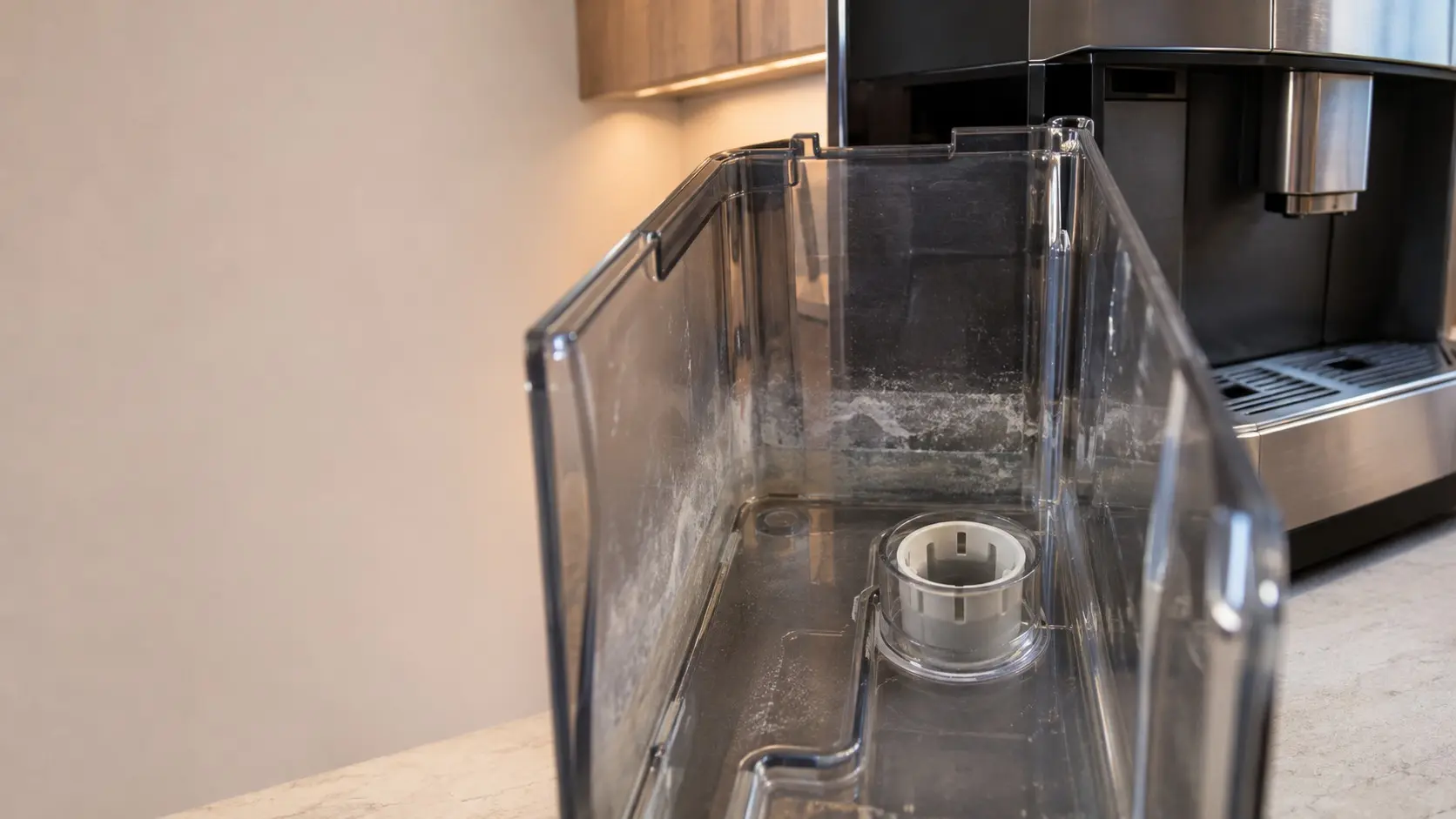
That film is a biofilm: microbes plus the slippery matrix they make to stick to a surface. A CDC journal review describes biofilms forming where a surface meets water, including drinking-water pipes, and notes they are highly resistant to most disinfectants. That is why scrubbing the wall and changing the water matter more than a splash of cleaner.
You may see a slick, clear coating, a pink or orange tint, or black spots near the seal. A musty smell from the tank is another sign. If you notice a smell without a visible film, why is my coffee machine smelly covers sour, musty and stale causes in detail.
- Clear and slippery to the touch: early biofilm, usually easy to wash off.
- Pink or orange: common surface growth in damp spots, wash and dry.
- Black spots at the seal or in a corner: scrub with a bottle brush and check the seal.
- Cloudy water or loose flakes: scale or growth, descale and rinse.
Source: Biofilms: Microbial Life on Surfaces (CDC Emerging Infectious Diseases) — biofilms form where a surface meets water, including drinking-water pipes, and are highly resistant to most disinfectants
What does the filter cartridge change?
A cartridge reduces some of the minerals that form scale and can improve taste, but it does not make standing water safe. A wet cartridge held in a tank for days can also become a place where film collects, and one left past its change date stops doing its job.
Soak and fit a new cartridge exactly as the manual says, flush it, and change it on the machine's reminder or on the time limit the maker states, whichever comes first. If a cartridge has dried out, check the manual, since some makers ask for a new one. For a hardness test and setting, see hard water and the coffee machine filter.
Table: Tank care by use
| Habit | Frequency | Why |
|---|---|---|
| Empty old water, refill cold | Daily, or every 1–2 days | Stops stale water sitting on the walls |
| Rinse tank, lid and float | Weekly | Removes the early film |
| Wash with mild soap, bottle brush | Every 2–4 weeks | Reaches corners and seal |
| Replace cartridge | On reminder or schedule | Keeps scale and taste in check |
How do you build a one-minute rinse routine?
Do the same four steps at the same time each day, such as when you start the first cup.
- Lift the tank and pour out any water left from yesterday.
- Swirl a little cold water around the walls and pour it out.
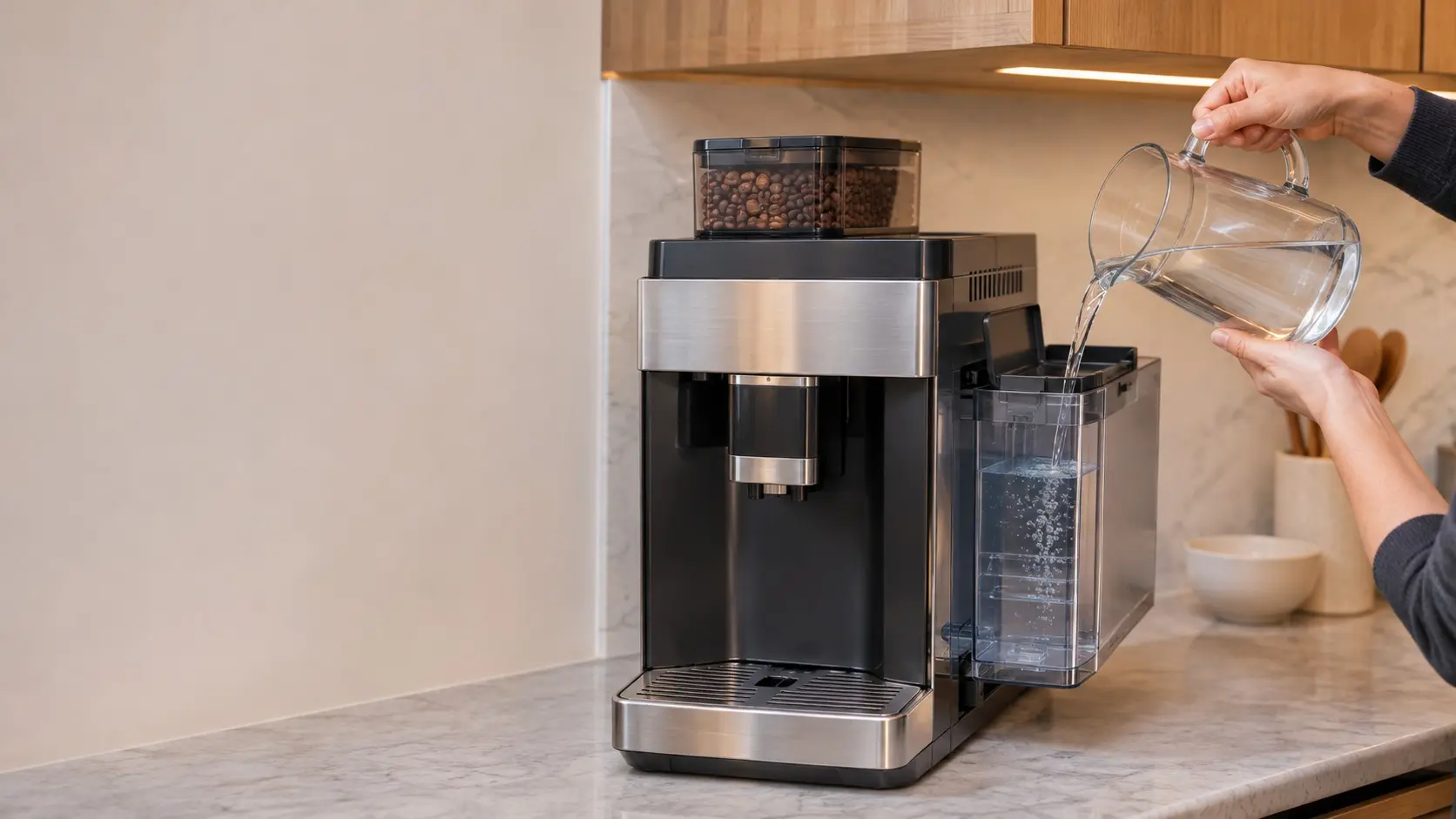
- Fill with fresh cold water to the max line, as the manual for many machines asks.
- Run a cup of hot water from the spout into a mug and discard it, to flush the line of overnight water.
Once a week, wash the tank with mild dish soap and a soft bottle brush, rinse it several times and let it air-dry upside down. Skip bleach or strong cleaners unless the manual lists one. Many are not made for the plastic, and any trace left behind goes into your cup.
What about vinegar?
The manual for many machines advises against vinegar for descaling because its acid can harm seals; use the maker's descaler on the schedule the machine asks for. Descaling a coffee machine explains the program.
When does tank water mean a service call?
If a clean tank grows film again within days, if the water has a strong odor, or if the machine's taste stays off after a descale and a full wash, the problem may be inside, in the lines or valves, not in the tank. A descaling service clears what the home program cannot, and a water line repair is the next step for a plumbed machine or a damaged line.
If the machine does not see the tank at all, see the water tank not detected page.
Does the water you use matter?
Yes, in two ways: taste and scale. Water with a lot of minerals leaves scale in the heater and lines, while very soft or distilled water can leave a flat cup, and the manual for some models advises against distilled water.
- Use cold water only; warm standing water is easier for growth.
- Match the hardness setting on the machine to your tap water, using the test strip it came with.
- Do not leave a tank in sunlight, which warms the water and feeds growth in clear plastic.
- If your tap water has a strong smell, the cartridge may not fix it; try a different water source.
A tank in a hot spot next to the stove or a sunny window will need cleaning more often than one in a cool corner. Where the machine stands is part of the routine.